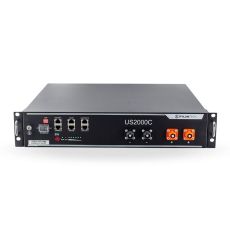
Description
Why lithium iron phosphate batteries?
Lithium iron phosphate (LiFePO4 or LFP) batteries are the safest of the traditional lithium-ion batteries. The nominal voltage of an LFP cell is 3.2V (lead-acid: 2V/cell). A 12.8V LFP battery is made up of 4 cells connected in series, and a 25.6V battery is made up of 8 cells connected in series.
Robust
- A lead-acid battery will fail prematurely due to sulfation:
If it is left in a deficient state for long periods (i.e. the battery is rarely or
never fully charged).
- If it is left partially charged, or worse, fully discharged (for yachts or motorhomes during
winter)
It is not necessary to fully charge an LFP battery. The lifespan even improves slightly when partially charged instead of fully charged. This is a major advantage of the LFP battery over the lead-acid battery.
These batteries have other advantages such as a wide operating temperature range, excellent cycle performance, low internal resistance and high efficiency (see below).
An LFP battery is therefore the chemistry of choice for demanding applications
Efficient
For several applications (especially off-grid solar and/or wind applications), energy efficiency can be of crucial importance.
The round-trip energy efficiency – discharge from 100% to 0% and back to 100% charged – of an average lead-acid battery is 80%.
The round-trip energy efficiency of a lithium-ion battery is 92%.
The charging process of lead-acid batteries becomes particularly inefficient when the state of charge reaches 80%, resulting in efficiencies of 50% or even less in the case of solar systems when several days of backup energy is needed (battery operating at a state of charge of 70% to 100%).
In contrast, an LFP battery will achieve 90% efficiency under light discharge conditions.
Size and weight
70% space saving.
70% weight saving.
High price?
LFP batteries are very expensive compared to lead-acid batteries. But for demanding applications, the high initial cost will be more than offset by a longer lifespan, superior reliability and excellent efficiency.
Bluetooth
The status of temperature and cell voltage alarms can be monitored via Bluetooth.
Very useful function for locating a (potential) problem, such as an imbalance in the cells, for example.
Our LFP batteries are equipped with cell balancing and monitoring functions. Up to 5 batteries can be installed in parallel and up to 4 12V batteries or 2 24V batteries can be connected in series: thus a 48V battery bank up to 1500Ah can be assembled. The cell balancing/monitoring cables can be connected in series, and they must be connected to a Battery Management System (BMS)
Battery Management System (BMS)
The BMS:
- Triggers a pre-alarm as soon as the voltage of a battery cell drops below 3.1V (adjustable setting between 2.85-3.15V).
- Disconnects or switches off the consumer load whenever the voltage of a battery cell drops below 2.8V (adjustable setting between 2.6-2.8V).
- Stops the charging process whenever the voltage of a battery cell exceeds 3.75V or the temperature exceeds 60°C.